

Chat with GQC
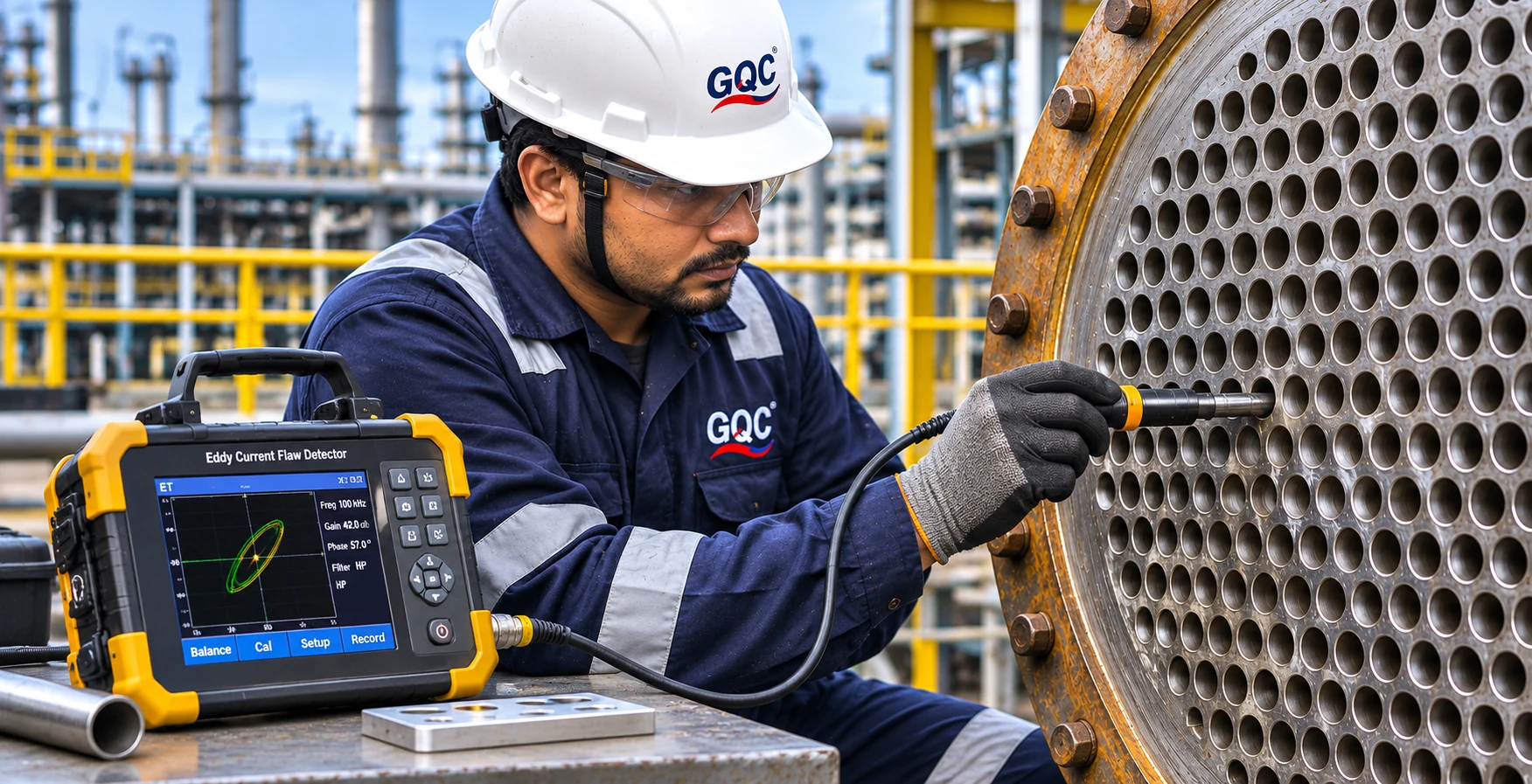
NDT TRAINING / ET
Eddy Current Testing (ET)
Explore electromagnetic testing principles, probe selection, equipment setup, signal interpretation and practical inspection applications.
ENQUIRE ABOUT ET TRAININGET COURSE TOPICS
ELECTROMAGNETIC PRINCIPLES
PROBE & SETUP
SIGNAL INTERPRETATION
Eddy current testing fundamentals and applications.
ABOUT THE METHOD
Eddy Current Testing Training
Eddy Current Testing (ET) uses alternating magnetic fields to induce electrical currents in electrically conductive materials. Changes in material properties or discontinuities affect the measured probe response.
Typical applications include surface crack detection, heat-exchanger tube examination and material sorting, using technique-specific equipment and calibration standards.
GQC training introduces electromagnetic principles, impedance response, probe configurations, calibration, interpretation and reporting.
TRAINING APPROACH
Course Highlights
- Electromagnetic induction and impedance
- Absolute and differential probe concepts
- Reference standards, calibration and lift-off
- Signal evaluation and practical inspection tasks
TECHNICAL FOUNDATION
How Eddy Current Testing Works
A changing magnetic field from a test coil induces eddy currents in conductive material. Variations caused by flaws, conductivity, permeability, geometry or lift-off influence coil impedance and the displayed signal.
Basic Inspection Sequence
- Review procedure and conductive-material application.
- Choose a suitable probe and test frequency.
- Verify instrument operation against reference standards.
- Establish reference phase, gain and sensitivity.
- Scan the component with controlled probe positioning.
- Interpret and document signal changes.
Typical Applications
- Surface-breaking crack inspection
- Heat-exchanger and condenser tube testing
- Conductivity and material sorting
- Selected coating and thickness applications
Technical limitation: ET is limited to electrically conductive materials. Conductivity, permeability, geometry, surface condition and probe lift-off can cause signal changes unrelated to defects.
COURSE PATHWAY
Eddy Current Testing — Level I
Learn instrument setup and fundamental ET examinations using established written instructions and approved calibration standards.
Level I Responsibilities
- Prepare equipment, probe and reference standards
- Perform checks and calibrations as instructed
- Carry out specified examination scans
- Identify and record signal responses
- Report results within assigned authority
Level I Course Syllabus
- Electromagnetic induction and eddy-current flow
- Conductivity, permeability, skin effect and frequency
- Probe and instrument fundamentals
- Impedance-plane displays and signal response
- Reference standards and system calibration
- Safety, practical limitations and reporting
Level I Practical Training
- Instrument checks and standardization
- Lift-off and conductivity-response demonstrations
- Scanning calibrated reference defects
- Basic signal recording
Level I training is not independent authorization to select a technique or approve findings. Follow the employer’s written practice and the qualified person’s assigned duties.
COURSE PATHWAY
Eddy Current Testing — Level II
Learn to choose ET techniques, characterize signals, assess results and prepare written instructions within the application scope.
Level II Responsibilities
- Select frequency, probe and scanning technique
- Verify calibration and reference suitability
- Interpret signals from material conditions and defects
- Evaluate findings against stated criteria
- Supervise examination and review reports
Level II Course Syllabus
- Advanced impedance and phase analysis
- Signal separation and frequency selection
- Surface and tubular ET techniques
- Calibration and sizing principles
- Codes and evaluation criteria
- Reporting and procedure instructions
Level II Practical Training
- Phase and sensitivity optimization
- Comparison of indication and lift-off signatures
- Evaluation of reference standards
- Preparation and review of ET records
PRACTICAL LEARNING
Train on Real Inspection Techniques
Supervised exercises connect classroom principles with examination procedures and industry applications. The equipment and exercise scope for each batch are confirmed before enrolment.
01 / THEORY
Impedance & Phase
Relate induced-current behavior to amplitude and phase responses.
02 / PROBES
Surface & Tube Examination
Probe selection, frequency and reference-standard exercises.
03 / SIGNALS
Interpretation & Reports
Recognize responses and document results against instructions.
TRAINING DETAILS
Course Information & Eligibility
Typical Initial Training Hours
| Training Level | Indicative Hours |
|---|---|
| Level I | 40 h |
| Additional Level II | 40 h |
| Combined Level I & II | 80 h |
Important: These figures are indicative training-planning references, not a guarantee of compliance for every edition, method, technique or certification route. The applicable written practice/standard and documented training plan govern. Course completion alone does not confer personnel certification.
Who Should Attend?
- NDT trainees seeking ET competence
- Heat-exchanger inspection technicians
- Materials and maintenance engineers
- QA/QC and asset-integrity inspectors
Training vs Certification: Course completion alone does not constitute ASNT or employer certification. For SNT-TC-1A-based personnel certification, the employer applies its written practice, examinations, experience and vision requirements.

Start Your Eddy Current Testing Training
Contact GQC for course schedules, learning objectives, practical equipment availability, fees and registration details.
Training and certification assessment are separate processes.
CONTACT GQC TO REGISTER